Suzanne Edison, MA, MFA

Poet • Educator

  • Suzanne Edison, MA, MFA
  • Home
  • About
    • Resumé
    • Contact
  • Blog
    • Poems
  • Teaching & Consulting
    • Events & Workshops
    • Testimonials
  • Resources
  • Poetry
    • Poems-Acknowledgements of Publication
    • Poetry Books

September 6, 2016 By Suzanne

Healing for Caregivers

Recently, I re-read an article that Catherine St. Louis wrote in The New York Times in 2014. She presented research about coping techniques for parent caregivers of children with chronic health needs. This paragraph stood out for me.

“All parents endure stress, but studies show that parents of children with developmental disabilities, like autism, experience depression and anxiety far more often. Struggling to obtain crucial support services, the financial strain of paying for various therapies, the relentless worry over everything from wandering to the future — all of it can be overwhelming.”

The research focused on two coping approaches. “The first group practiced meditation, breathing exercises, and qigong practices to hone mental focus. The second received instructions on curbing negative thoughts, practicing gratitude and reclaiming an aspect of adult life. Both groups were led by specially trained mentors, themselves the parents of special-needs children.”

Not surprisingly, both groups reported reductions in stress and anxiety and even “how to redirect their anxiety into positive action.” The group given the meditation techniques seemed to report greater reductions in anxiety.

When my child was diagnosed with an autoimmune disorder I also experienced high levels of stress, anxiety, sleep deprivation and fear. It was then that I refocused my writing journey to include all of what was happening in my life. I found great relief and new wells of creative energy. I became a better advocate for my daughter too.

I have had similar reports from parents in my Writing as a Righting Journey workshop where we use writing and body awareness to help reduce anxiety and find ways to channel it into creative, and more productive thinking and action.

Next week I’ll be presenting my work at an international health humanities workshop in Spain and in November, I’ll share some insights of my work at a Mayo Clinic conference in Phoenix, Humanities in Medicine. Stay tuned.
Filed Under: blog, literature review, workshops Tagged With: caregivers, healing, writing

March 27, 2016 By Suzanne

Writing as a Righting Journey-Moving Forward

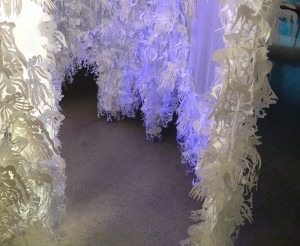
paper cut show-MFA BostonWhy write.

I’ve written about writing and healing often. Writing workshops are what I now offer to other parents as a way of containing and expressing our experiences living with a child(ren) who has a life threatening or chronic illness. I recently came across an article on this subject on the Foundation for Art and Healing website from last year. I was reminded about Dr. James Pennebaker’s research on this subject and I want to go back and reread his work, Writing to Heal, now. You may find it of interest also.

There are many powerful reasons to write, but HOW we write is as important as the writing itself. Being able to construct a narrative from our emotions, or use metaphoric language as a container for the hard to express feelings, allows us to gain some perspective on what may feel overwhelming. I think it allows us to move from feeling to cognition.

I structure writing exercises so that participants have the time to let down into their feelings and experiences, but also have the opportunity to create a meaningful story or poem that provides a container for feelings. This sort of writing engages the prefrontal cortex, that part of our brains where decision making and discernment reside. This capacity to feel and contain is necessary for making judgements about treatment plans, advocating for our child’s needs and for adherence to the treatment plan. It helps move us from despair or depression about our circumstances to resilience and repair.

There is a caveat. Most of us don’t move through our feelings of grief or loss, anger or depression once and then never feel them again. We come back again and again to these experiences as our children get better and grow or don’t. Hopefully, writing allows us a mechanism for continuing to better understand what we feel and what we need for our own self-care and for our children.


Filed Under: teaching Tagged With: healing, James Pennebaker, narrative, poetry, writing

November 28, 2015 By Suzanne

Inner/Outer Landscapes

inner-outer landscape

Yesterday afternoon and into evening, I sat writing, next to a window with a view to the Puget Sound and Olympic Mountains. I seemed able to sit there for a long period of time, every once in awhile glancing up from my computer to note the trajectory of the sun and the corresponding shadows. I felt the heat from the sun reflecting off the water, and its shimmer. I worked on several poems and was aware of time only as the colors of the sky changed from blue to yellow-green to a deep orange.

It is easy to find a writing rhythm when I retreat to a place removed from the city.  But I often take a walk in the city through a green-space or near a body of water when I come to an impasse in my writing and need new ideas.

Sometimes nature itself informs the words of my poems. I love the spiral patterns in a moon snail shell,moon snail shell

and the harmonic, Fibonacci sequence seen in sunflowers, or the eddies of water and sand.sand eddies

Nature’s effect on the brain and creativity has been the subject of research for a few years. Though many of us have understood intuitively the necessity and rewards of being outdoors, of hiking in the mountains or walking in a park or on a beach, we can now point to brain research that confirms this awareness. We might want this added information as we think about providing nature, or natural environments to people in the hospital. Or, knowing the way nature recharges our brains, lowering cortisol levels and stress, making it easier to learn, we can confirm the need for kids to be outside and around the natural world for some parts of their day. Richard Louv wrote about this 10 years ago in his book, Last Child in the Woods, and it is even more true today; we have a harder time disconnecting from our wired world.

Now, that you are finished reading, go for a walk!


Filed Under: essays Tagged With: brain, health, nature, writing

August 17, 2013 By Suzanne

The Art of Losing

I highly recommend a book of poetry edited by Kevin Young called The Art of Losing: Poems of Grief and Healing.
The title is from Elizabeth Bishop’s poem One Art. I got a hardback version at a book closeouts website through Amazon (forgive me independent bookstore lovers) for about $8 + shipping.

I want to quote Kevin’s opening lines in his introduction as a way to bring you into wanting to also get the book.
“I have begun to believe in, and even preach, a poetry of necessity. This is a recognition not just of the necessity of poetry to our lives, but also the fact that necessity is what drives most of the poetry that matters, or the way that it matters.” And, “a poem must be willing to be unwilled, beckoned by need.”

And this book is filled with poems driven by need: elegies, remembrances, dedications, words that attempt to point towards the things that are often unspeakable, or seemingly feel that way.  I love the way I am drawn to think about other forms of art, painting and music, as I read different poems. I thought about Ad Reinhart and his seemingly monochromatic paintings in all black and all red. They beg us to be absorbed into them, by them. They seem to hover around those “almost unspeakable realities” and yet, we keep trying to find the words and images, sounds and visuals to express our ineffable lives.

The Art of Losing is a remarkable compilation of poets living and dead, from W.H. Auden, Emily Dickinson, Anne Sexton to Dean Young, Robert Hass, Lucille Clifton, Adam Zagajewski, just to name a few. And there are so many, many more.  For what greater mysteries are there than death, love and living.

As William Faulkner is quoted in the opening section called Reckoning:

Between grief and nothing, I will take grief.

Theodore Roethke says in the section, Recovery:

I learn by going where I have to go.

And finally, Philip Larkin opens the last section, Redemption with:

What will survive of us is love..

Filed Under: Art & Writing, literature review, other writers, poetry Tagged With: grief, healing, poetry, writing

  • « Previous Page
  • 1
  • 2
  • 3
  • 4
  • 5
  • Next Page »

Events & Workshops

Been Gone Too Long

Available to Teach Writing Workshops for Caregivers, Patients, Medical Providers

Workshop Opportunities: FREE

SEE MORE

Recent Posts

Nature of Our Times

September 21, 2025

Photo Poems

May 3, 2025

Mental Health and Juvenile Myositis

November 29, 2024

All things Books, Poems, Teaching/Workshops etc.

February 14, 2024

Poems in the World, Readings, Teaching

March 15, 2023

Follow Suzanne

  • Facebook
  • LinkedIn

Post Categories

Blog Archives

  • Contact Suzanne
  • Connect on Facebook

Copyright © 2026 Suzanne Edison Site by LND · Banner artwork by Leslie Newman